


The Real Road to AWS Solutions Architect Associate Certification
This article puts the myth to rest that dumps aren’t the way to get an AWS Certified Solutions Architect Associate (SAA-C03) certification. Instead, what really matters is actually understanding AWS, thinking like an architect and being able to put AWS services into practice not just copying answers from a dump. This guide goes into the exam format, the core AWS services, the AWS Well-Architected Framework and some effective study techniques, all advocating that proper study and hands on experience should be your main priority over the quick fix route. The aim is to give anyone aspiring to be an architect the mindset and the know how to build really robust, secure and cost effective solutions on AWS. This is what leads to real competence and a real career boost.
Navigating Your Path Toward Solutions Architect on AWS
The AWS Certified Solutions Architect Associate is not just a line in your resume. It is confirmation that you can create secure, resilient, efficient and cost-effective systems in the Cloud.
The Worth of Being an AWS Certified Solutions Architect
This designation is always among the highest-paying IT certifications. But the real price isn’t only a hypothetical salary hike. It’s in the structured knowledge it demands you accumulate. You get to learn to think about systems in a holistic way, with capabilities ranging from user identity and data encryption all the way up to serverless workflows at web scale or massive data lakes. It’s a basic toolkit for the cloud era we live in.
Why a Definitive Guide? Beyond Quick Fixes and “Dumps”
The internet is full of easy passes. There are GitHub repos called “AWS dumps,” websites advertising “real exam questions.” AWS add new questions to these exams all the time and don’t make any secret of the fact. But, most crucially: no one learns a single thing about architecture by committing answers to memory. This guide is about the reverse: building understanding from the ground up.
What’s inside this guide? The map out for real success
We’re not going to give you answers to memorize. Instead, let’s chart the territory. We will dissect the mentality of the architect and get your thinking cap well adjusted to AWS dumps. We will deep-dive into the essential AWS services, learn how they fit together, and gain ability to make informed decisions about IT solutions for AWS workloads. Lastly, we’ll cover how to use your learning under test conditions.
Why Real Knowledge Matters for AWS Google Search Architect
What’s an architect to do, after all, but to decide within constraints? In reality, needs change, services mature, and new best practices are released. If you’ve only learned from what you’ve memorized on a list of things by looking at AWS dumps, then well, now you are paralyzed. True understanding allows you to learn, to reason from first principles, and create solutions. It turns you into someone who can recite answers to someone who can solve problems.
About the AWS Certified Solutions Architect – Associate (SAA-C03)
This exam is for anyone who performs a solutions architect role and have one or more years of hands-on experience designing available, cost-efficient, fault-tolerant, and scalable distributed systems on AWS.
Without understanding the enemy, we cannot properly engage. The SAA-C03 is a 65-question multiple-choice, multiple-answer exam that you have 130 minutes to complete.
Exam Blueprint Deconstructed: What to Anticipate
The exam evaluates your proficiency in four domains, with the following weight:
- Design Secure Architectures (30%): This is the main part. It includes IAM, protection of data, infrastructure security and incident response.
- Design Resilient Architectures (26%): This relates to scalable and highly available design, leveraging such services as ELB, Auto Scaling and multiple AWS regions.
- Design a High-Performing Architecture (24%): On this topic, you must be able to choose storage and compute resources based on performance and cost.
- Design Cost-Optimized Architectures (20%): This evaluates your process of dissecting costs and choosing the appropriate resources and pricing model.
Skills Tested: Thinking Like an Architect
Forget simple recall. The exam evaluates:
- Analysis: Are you able to break a large problem down into a set of requirements?
- Assessment: Can you consider the trade-offs of different bundles of services?
- Application: Can you apply the principles of the AWS Well-Architected Framework to a problem?
Architect’s Frame of Mind: Building Solutions, Not Just Taking an Exam
That, my lovely readers is changing one’s point of view. You’re not a college kid throwing up in a garbage can and cramming for exams; you’re a consultant supposed to deliver some kind of product or outcome.
Shifting from Memorization to Application
Understand when you would use S3 Standard for your high demand web content, how long term archive can be done with S3 Glacier and Lifecycle policies to automate a move between them so that the lowest cost storage is utilized.
- Business Requirements First: How to Translate Project Needs into Technical Specifications
- Each exam question is built around a business demand.
- Key phrases are your guide: “Cost-effective” or “minimize cost” refers to serverless, spot instances, or reserved capacity.
- For “highly available” or “fault-tolerant”, one ends up requiring multi-AZ or multi-Region architectures.
- “Real-time” means Kinesis rather than batch processing with Glue.
- Your first task is to map out these keywords into architectural priorities.
Adopting Best Practices: The Well-Architected Framework as Your Guide
This is your number one tool. The AWS Well-Architected Framework is a formalization of good practices established by thousands of customer reviews. It’s made up of six pillars that we’ll go into in the next section. But take this to heart for now: if you interpret every practice question and real-world problem through the prism of these pillars, fewer bad decisions will be made.
Foundational Services: The Building Blocks
You have to know your way around them by now. Not merely know them, in isolation; know how they connect.
- Calculate: EC2 (virtual servers), Lambda (serverless functions). Know when to use each.
- Storage: S3 (object storage), EBS (block storage of EC2) and EFS (file storage).
- Database: RDS, DynamoDB (NoSQL). Know the trade off between SQL flexibility and NoSQL scale.
Security & Identity: Securing Your Foundation
Security is something that is not a feature, but the base; they mark it down the highest during the exam.
- IAM (Identity and Access Management): This is huge. Understand policies, identities, and least-privilege principles.
- Detection: Understand the use of AWS CloudTrail (logs API calls) and Amazon GuardDuty (threat detection).
Control & Monitor: Get Your Kitchen Under Control
You should determine if your system is in health.
- AWS CloudWatch: The primary monitoring service to receive metrics, logs and alarms.
- AWS CloudTrail: Your governance and compliance audit trail, as I described.
Advanced Services & Combos: Building intricate treatments
The exam is really testing if you can roll services into solutions.
- Floppy transfer: Use SQS (queues) and SNS (notifications) to let applications communicate floppy, tight coupled / scalable
- Orchestration: Use AWS Step Functions to orchestrate multiple serverless functions.
- Analytics: Understand the use case for Amazon Athena (a service that allows you to run ad-hoc queries on S3 using SQL) and Amazon Kinesis (real-time data streams).
The Well-Architected Framework: Your Blueprint for Success
This framework is metaphorically the official AWS checklist for good architecture. Let’s take apart what each pillar means, because it is exactly this that the AWS Solution Architect Associate exam questions are testing.
- Operational Excellence: Running and Monitoring Your Solutions
- This is about the ability to run workloads effectively, get insight and improve constantly.
- One key question: How can you know the ‘health’ of your workload?
- Another exam focus: working with the AWS-managed operational services such as CloudWatch for monitoring, CloudTrail for auditing, and, of course, automation.
Security: Safeguard of Information Systems, Data and Assets
We did talk about this a little, but the framework emphasizes it. It’s all about having a strong identity Foundation, being able to trace and secure at each level.
- Key Question: How do you secure your data at rest and in transit?
- Exam tip: IAM, encryption (KMS) and the shared responsibility model.
A reliable system does not experience a failure, but performs its function as expected.
- Key Point: How does your design handle the failures of components?
- Exam Tip: Be sure to consider implications for high-availability (multi-AZ), fault-tolerance (auto-recovery) and how you will be scaling for load with Auto Scaling.
Performance Efficiency: How to make the best use of processing ability
It´s a matter of picking the right kinds and sizes of resources, then keeping them efficient as demand changes. Here’s the issue though: how do you pick an architecture which performs well?
- Exam Focus: Choose between instance families, caching (ElastiCache), storage performance.
- Cost Optimization: Avoiding Unnecessary Expenses
Sustainability: Minimizing Environmental Impact
The latest leg is dedicated to achieving maximum energy efficiency.
- Key Question: How are you going green with your cloud workloads?
- Exam Tip: Maximize usage (not idle servers), choose efficient hardware (Graviton processors) and optimize your data storage life cycle.
Strategic Study Techniques: Preparing to Succeed on Your Exams
Now, how do you actually learn all this stuff?
Official AWS Material: A Reference You Really Need To Read.
Start with the source. The official AWS Exam Guide and the AWS Whitepapers (like “Overview of Amazon Web Services” and “Well-Architected Framework” paper) are must-haves. They are the truth against which all else is measured.
Real Life: Dispatches from the Trenches
There are some things you cannot read about from a book on architecture. Use the AWS Free Tier. Build a simple web application. Break it, fix it, make sure it’s secure, do it for little money. The feels are the practical stuff you can learn out of a book, and that’s just precious remnant left after theoretical knowledge!
Structured Learning Paths
Don’t forget to look at the instructor led classes (either run by AWS or through their approved partners) as well as very good video courses that can also be found on these official platforms. They organize the deluge of data into a coherent learning path.
Practice Makes Perfect: Getting in Shape for Exam Conditions
Practice tests are important, but they need to be the right kind.
The Importance of Good Practice Tests
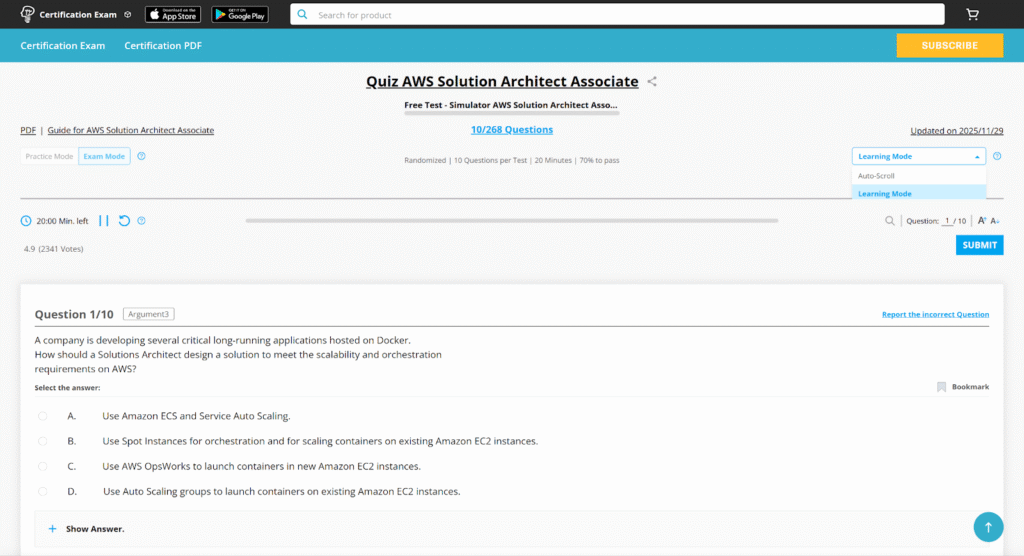
Reputable practice tests such as the ones from Certification-Exam will mirror the format and scenario based nature of the exam. They are meant to instruct, not just assess. Unlike the question banks, their platform includes a Mobile App to allow you to study whenever and wherever. With a Practice Mode to learn the material and an Exam Mode to simulate the actual exam, you can practice taking the Insurance Exam as many times as you would like. Every question is accompanied by an explanation that has been meticulously referenced with all the official documentation from AWS to deepen your understanding and to assist you in remembering the information.
Reviewing Right Answers: All For the “Why”
This is practice in the profoundest sense. After every right or wrong answer read the explanation. Why the correct answer is best? Why are each of the wrong ones wrong? This analysis exercises the reasoning muscle you will need to pass the actual aws solution architect associate exam questions.
Test Day Tips: How to Perform on the ACT or SAT Under Pressure
You know the material. Now, you need to execute.
Time-Management Strategies for the Case-Happy Test
You have 130 minutes for 65 questions, or approximately two minutes per question. Don’t get stuck. Immediately flag difficult questions and move on. Your first pass should be to answer all and only those questions you are confident about.
Decoding the Exam: Knowing What to Look for in Questions
Now read the last sentence of the question to see what is needed. Then, reread the scenario and underline key phrases: “cost-optimized,” “highly available,” “least management overhead.” These are very explicit references to the constraints of the solution.
Eliminating Incorrect Answers: Strategic Guessing
This usually allows you to eliminate one or two answers outright as clearly incorrect (ex: an answer that doesn’t encrypt data when the need explicitly says “encrypted”). This increases your odds, in case you have to guess.
Pre-Test Prep: Logistics and Mindset
- Logistics: If attending online, use your computer to take the system test from your room.
- Clear your desk: Tell them they should not interrupt you.
- State of Mind: Don’t lose sleep at night. Take some warm-up questions to keep your skills warm, but don’t cram.
Summary: Your AWS Path to Ultimate Victory
The journey to become an AWS Certified Solutions Architect is not an easy one by any means. It’s meant to separate those who’ve put in the work from those looking for a shortcut.
Recap: Success is earned through understanding
We’ve already discussed how to start thinking like an architect, how to become an expert at services and the Well-Architected Framework and study smartstay testing ahead of time. This is the real path. It’s more difficult, but it’s the only one that will result in true competence.
What to do next: Go Build, Go Learn, Go, Architect
- Bookmark the official SAA-C03 Exam Guide.
- So go out and sign up for the AWS Free Tier, then do something, anything, JUST DO IT today.
- Pick one high-quality, explanation-centered practice test resource and start applying what you are learning.
The certification is part of the process, not the end. The journey to that positive future starts by rejecting the shortcuts provided for us in the form of AWS Solution Architect Associate exam questions and takes you down a path of learning one concept at a time.